Best Coffee Beans: India

The Love of a Cow and a Bit of Coffee So, we are going to get to the best coffee beans from India. But let's take a look at the worst first. . . ju...


The Love of a Cow and a Bit of Coffee

So, we are going to get to the best coffee beans from India. But let’s take a look at the worst first. . . just because it is fun.

Here is an excerpt form Stewart Lee Allen’s The Devil’s Cup (1999, p. 81):

India produces the world’s most consistently vile cup of joe. It is never fresh-brewed but made with instant ‘flakes,’ which are boiled with milk, sugar, and nutmeg. The resulting stew is best described as a sickeningly sweet, piping-hot milkshake, the memory of which is a dark blot upon my soul. The whole thing is not only vile, it’s illogical. Tropical cuisines worldwide avoid dairy products like the plague. Here they were worshiped. How could a culture with such fine cuisine be content with such a perversion?

Well, Allen got his answer and, I have to say, the next several pages of the book gives the most beautiful, most passionate, most spiritual description of milk that I have ever come across. But I won’t tell you what that description is. Why? Because I am giving you something better–a reason to read a great book.

Best Coffee Beans: India

OK, India favors tea over coffee and when they drink coffee they prefer it instant with lots of milk. Should you do yourself a favor and stay away from Indian coffee altogether? Nonsense! In Southern India, great coffee is grown and enjoyed.

  • Coffees from India are shade-grown.
  • Coffee, spice, and fruit grow together on plantations in India.
  • Monsooned Malabar is a top-notch coffee from India. It is called “monsooned” because it is exposed to monsoon winds (which swells the bean and makes the coffee less-acidic). Malabar is a region in Southern India.
  • Timothy James Castle (author of The Perfect Cup) mentions Monsooned Malabar as one of the best that India has to offer.
  • Monsooned Malabar is dry processed and is often said to have a musty flavor (common to aged and monsooned coffees).
  • Monsooned Malabar is a full-bodied coffee with a spicy aroma.
  • Mysore was the location of the Kolar Gold Fields (gold mine) and coffee plantation. This is where the name Mysore ‘Nuggets’ comes from.
  • Mysore Nuggets coffee beans are arabica. This coffee is wet processed.
  • Mysore Nuggets is a sweet coffee with a complex aroma and a hint of spice.
So have the best of both worlds, read a great book that speaks of the horrors of Indian coffee while drinking a great cup of coffee. . .from India!

    Best Coffee Beans: Brazil


    So, you are on the look out for a great cup of coffee. Good for you. But before you put your money down, take a look to see if this coffee is for you. . .

    Best Coffee Beans: Brazil

    • Overall, Brazilian beans have not been regarded as high-quality and have often been used in blends.
    • In Brazil, the dry method (also known as unwashed or natural) is primarily used–a process that can sometimes give the coffee an earthy (or dirty) smell and/or taste.
    • Brazil mostly produces arabica beans (the dry processing method is known to lower the quality of the arabica bean).
    • It is often said that the best Brazilian coffee comes from the Sao Paulo Region.
    • Sweet Maria’s finds that the best Brazilian coffee comes from the Sul de Minas, Mogiana, Cerrado and Matas de Minas regions.
    • Bourbon Santos (Santos is a busy port in Brazil) is a high-quality coffee from Brazil.
    • In The Perfect Cup, Timothy James Castle (1991, p. 39) describes  a good Brazil as “medium bodied and very mild in acidity. The best Brazils have a complex and balanced aroma and a taste and mouthfeel that is sweet and lingering. A dry spiciness that includes hints of allspice and cloves in usually a characteristic of good Brazils.”
    • Brazil is out to reinvent itself (by changing its processing methods) into a country that grows high-grade specialty coffee.
    • Brazil is a world leader in coffee production.

    Now sit back and enjoy a song by Ol’ Blue Eyes

    There is No Such Thing as Espresso Coffee Beans


    Yes, that’s right. There is no such thing as espresso coffee beans. What makes an espresso an espresso is not “espresso coffee beans”, but rather the grinding and the brewing of the coffee beans.

    How to Make an Espresso:

    Any type of coffee bean or level of roast is used to make espresso, though many coffee lovers prefer to roast differently for espresso as opposed to drip coffee–a darker roast works very well for espresso. This is because a darker roasted coffee bean is less acidic, which reduces the high acidity that is usually created through the espresso brewing process.  But it is a matter of preference.

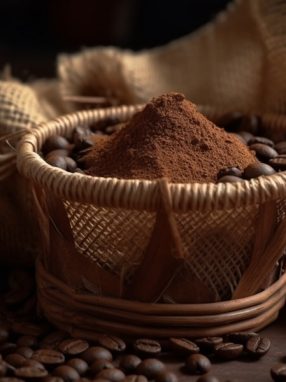
    The ground coffee beans  for espresso have a much finer consistency than the more coarsely ground beans of regular coffee.  Also, like any great coffee drink, the “espresso coffee beans” are ground to order which adds a nice sense of ritual to each espresso making occasion. . .coffee is at its best when freshly ground.    To brew this concentrated coffee drink, high pressured steam powers hot water through the finely ground coffee beans. And voila (excuse the French), now you have this Italian born beverage ready for the sipping. . .or the gulping.

    How to Drink an Espresso:

    Many espresso drinkers take espresso alone in an espresso shot, or shots for those who can take the jolt. Some enjoy to stir their espresso before consumption to mix the sweetness found at the bottom of  an espresso throughout the drink.  Others see espresso as a layered drink and like to experience the changes with each sip.  And still, many other espresso lovers enjoy their beverage blended with other liquids entirely.  Here are some popular examples:

    • Americano or Cafe Americano–Espresso with hot water.
    • Breve–Espresso with steamed half-and-half.
    • Cappuccino–Espresso with milk steamed to foam (dry cappuccino has more foam and wet cappuccino has more milk).
    • Iced Coffee–Chilled espresso over ice with milk.
    • Latte–Espresso with milk steamed to slight foam.
    • Mocha–Latte with chocolate.
    • Red Eye or Black Eye–Regular coffee with espresso shot(s).

    And Finally, How to Love Espresso (as if you didn’t already know. . .)

    Coffee creates its own atmosphere.  Perhaps what you enjoy most about your coffee drinking experience is the aroma, or maybe its the taste, or sipping a cup with your best friend or while reading a good book; but no matter your reason for loving coffee–you are not alone.  If you are an espresso lover, you are certainly not alone!

    Now you know about  ”Espresso Coffee Beans” and the drinks they make, you are ready to go to the local café and enjoy a cup of your own.  Better yet, buy an espresso machine for your home or even learn the art of home roasting to truly experience the act of creating a great cup of coffee.

    Who’s Your Girl? Arabica or Robusta


    Arabica

    It will be years before you have her, but you wait. The soil of Kings and Queens raise her in the high, far-off corners of the world, and you wait. She’s adorned with fragrant white flowers on days the sun chooses her… and when she’s ready, she blushes red and purple.  Don’t take her too soon and don’t take her too late. One misstep and you ruin her. She’s wrapped in cherry and her shade of skin will inspire your action. You watch with love and wait with attention. She knows when you look away. She falls when you look away… and you have lost her.

    If you dance around her character just right, she lets you taste her. You love her… and you wait for her again. But remember, she has a bad day on occasion.

    Robusta

    She’s bitter, but she grows – you won’t easily get rid of her. She knows how to rough it and she’s a jolt down the throat. She wants to fulfill your need of her in your bloodstream, but if you have refined wants – you’re on your own. She’s sometimes hard to swallow, but she doesn’t depend on your changing moods to live.  She thrives. She laughs when you try to knock her out of her tree, but she  leaves it up to you on how to use her – she can take it.

    She gets you through the day and puts hair on your chest… but hold on, because sometimes she surprises you… if you surprise her with a little care and cleaning up.

    Who’s your girl?

    Arabica coffee beans or Robusta coffee beans? Some choose one or the other and some play the field.

    Enjoy life and enjoy your coffee – no matter your type!

    Caffeine, Health, Literature, and a Longing for the Sacred


    The Great Connection Between Literature and Caffeine

    So, we all remember the great German novelist, poet, playwright and scientist Johann Wolfgang von Goethe, right?  Well, believe or not, he had a hand in the discovery of caffeine. In The 100 Most Important Chemical Compounds (p. 56), Myers discusses this discovery.

    CaffeineOn one fateful day, Goethe visited a lab where Runge (a German chemist and physician) was working. After witnessing Runge dilate the eye of a cat with a substance he removed from a nightshade plant, “Goethe awarded Runge with a sample of rare coffee beans and challenged him to determine the compound that gave coffee its stimulating effects. After several months, Runge isolated caffeine from coffee in 1819.”

    Caffeine has Quite the Family

    Caffeine is an alkaloid. Alkaloids occur in nature in both plants and animals. Cocaine, morphine, and caffeine are all examples of alkaloids. The color, of most alkaloids, is white and the taste is bitter, as is with the alkaloid caffeine. As stated in The World of Caffeine (p. xx), “Many alkaloids present a double face, exhibiting both poisonous and curative properties.” It then comes as no surprise that coffee, in the early days, was used as a medicine.

    What Caffeine Really Does

    In An Orchard Invisible (p. 161), Silvertown tells us what caffeine really does. In our body, there is a natural substance that builds up in us throughout the day causing us to relax. This natural substance is called adenosine and it eventually puts us to bed. I sum up the process like this: caffeine is like a bouncer who won’t let adenosine in the club. Inside the club is the central nervous system, and caffeine isn’t going to let adenosine in to ruin the party. Caffeine keeps the club (nervous system) nice and hype. Well, for while anyway. Caffeine does not stay in the body for long.

    Caffeine and Your Heart: Literally & Figuratively

    As stated above, caffeine does stimulate the nervous system but it does not stay in the body for long. It does raise blood pressure, but as stated in an article entitled “The Caffeine Advantage” in Men’s Health, those who drink coffee on a regular basis have half the chance of dying from heart failure as non-coffee drinkers. The article also says, according to Harvard researchers, there are some advantages to drinking caffeinated coffee in regards to preventing Parkinson’s disease as well as diabetes. Just lay off the sugar and take care if you are someone who is sensitive to caffeine or has high blood pressure

    I have to admit that my favorite discussion on the benefits of caffeine came to me from Stairways to Heaven (p. 136) which states that “coffee has a ritual element” and finishes that thought with these wonderful words:

    This ritual element helps lift persons out of their workaday mind-sets and prepares them to embrace the “finer” things in life. The physiological effects of caffeine consumption, no less than the set or setting, also help produce a Zen-like “fresh way of seeing things.” Enhanced mental alertness and increased sensory alertness combine to help us appreciate new dimensions or an added richness to what are otherwise ordinary experiences. Few Americans consume coffee in social or ritual contexts that might transform their experiences into one of quite the same spiritual magnitude as Zen Buddhism’s satori. Yet by the hundreds of thousands they have found coffee drinking to be crucial to such spiritual activities as flowing conversation, intimate readings, and intellectual discovery. And in this sense these Americans have found that coffee, in a matter at least approximating Zen satori, is capable of awakening them to the fact that the sacred (i.e., what is precious, truly important, intrinsically worthwhile) is in the here and now of everyday life if we can but learn to see it.

    And I think that sums up an article about caffeine in a way I could never even attempt.

    So, go forth and enjoy your coffee.

    Reference List

    Bealer, B & Weinberg, B 2001, The World of Caffeine: The Science and Culture of the World’s Most Popular Drug, Routledge, NY, p. xx.

    Myers, R 2007, One Hundred Most Important Chemical Compounds, Greenwood Press, CT, p. 56.

    Fuller, R 2000, Stairways to Heaven: Drugs in American Religious History, Westview Press, Colorado, p 136.

    Griffin, L March 2008, ‘The Caffeine Advantage,’ Men’s Health, pp. 102-104.

    Silvertown, J 2009, An Orchard Invisible: A Natural History of Seeds, The University of Chicago Press, Chicago, p. 161.

    Get Adobe Flash playerPlugin by wpburn.com wordpress themes